
Pad-Mounted Distribution Transformer: A Custom Transformer Explainer
A pad-mounted distribution transformer is a distribution transformer installed at ground level on a concrete pad, with its high-voltage and low-voltage switching, fusing and protection enclosed together with the transformer inside a tamper-resistant steel enclosure. The pad is only the mounting surface. The enclosure is what allows the equipment to stand in a public place — a pavement, a car park, a residential lot — without a fence around it. Phase configuration, capacity, voltage class and protection package all follow from that installation logic.
Readers arriving at distribution equipment for the first time usually get stuck on three things, and none of them is electrical theory. Is pad-mounted a product or a way of installing one? How does a single-phase unit differ from a three-phase unit in practice? And how much of the specification has to be settled before an enquiry can be sent? This explainer works through those questions in order. It uses the ZGS-H/ZGS-Z series, rated 75–2500 kVA, as a worked example for North American grids in the United States, Canada and Mexico, and keeps ANSI/IEEE compliance, UL/CSA certification and the 4.16–34.5 kV high-voltage classes where they belong — as basic selection context on the data sheet, not as the subject of a certification guide.
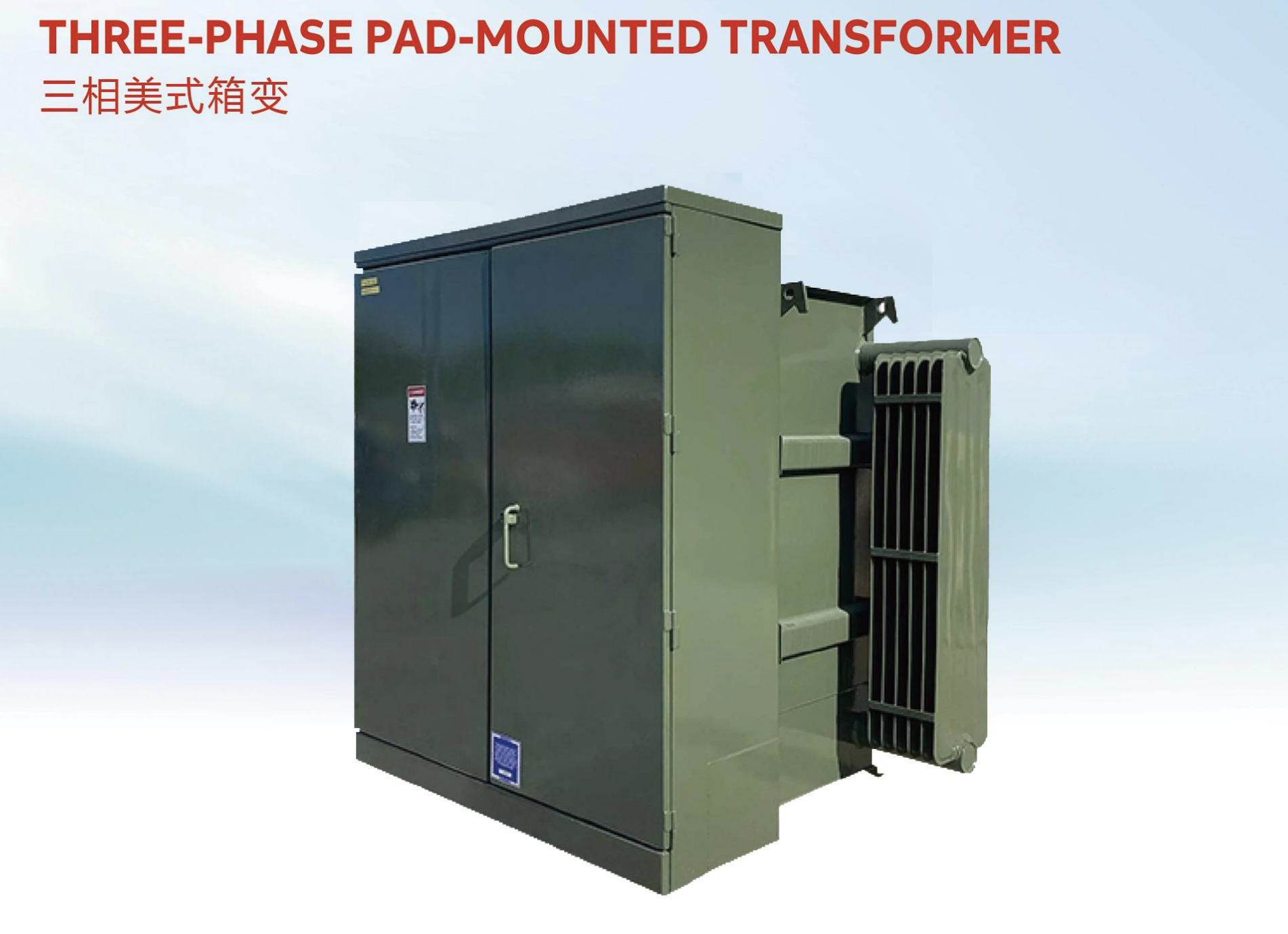
Three-phase pad-mounted distribution transformer, ZGS-H/ZGS-Z series, 75–2500 kVA, outdoor pad-mounted construction.
The problem: three questions that block a first specification
A newcomer is rarely confused about what a transformer does. The confusion sits earlier, at the point where a project has to decide what type of equipment to ask for. Those three questions are worth answering before any capacity or voltage figure is discussed.
Is pad-mounted a product or an installation method?
It is both, and that is where the ambiguity starts. The transformer inside the enclosure is a liquid-filled distribution transformer; what turns it into a pad-mounted unit is the combination of the tamper-resistant enclosure, the dead-front termination and the concrete pad. Compartmental construction, dead-front design, radial or loop feed and tamper resistance are the features that define the category, not merely decorate it. That matters for procurement: two suppliers can both offer a 500 kVA distribution transformer, but only one of them is offering a unit built to sit unguarded on a public footpath.
Which phase configuration does the load need?
Single-phase pad-mounted units serve residential loads, street lighting and small retail. Three-phase units serve commercial, industrial-park and renewable-distribution loads where a three-phase supply is required. The reference guidance behind this article recommends single-phase pad-mounted or pole-mounted units in roughly the 25 kVA to 100 kVA band for North American residential and small commercial distribution, with 50 kVA and 75 kVA units at 7200/2400 V and a 120/240 V secondary common in service, and three-phase pad-mounted units wherever commercial or light-industrial loads need three-phase supply. The two are separate product families with different windings, bushings and enclosure layouts — not a checkbox on one unit.
What must be decided before an enquiry is sent?
Eight items, and they are decisions rather than preferences: phase count, rated capacity, high-voltage class, low-voltage voltage, frequency, efficiency target, enclosure material and finish, and the internal protection package. A supplier who receives those eight items can quote a defined unit. A supplier who receives a generic request can only describe a category, and the gap between the two shows up later as drawings that do not match the network.
Industry background: why North American distribution uses pads
In North American practice, pad-mounted equipment exists because residential and commercial distribution moved underground. Once service drops and laterals are buried, a pole is no longer a natural home for the transformer, and a fenced substation is disproportionate for a few hundred kVA serving a housing estate. The pad-mounted format resolves both problems at once: the unit can be placed close to the load at ground level, and the tamper-resistant enclosure allows it to stand in publicly accessible areas without a fence.
The reference knowledge for this category describes pad-mounted transformers as the standard solution for underground residential and commercial distribution in North America, with ratings in service typically between about 25 kVA and 500 kVA, and notes that units are certified to the UL and CSA standards for liquid-filled distribution transformers rated over 750 V, with CSA C2.1-06 and CSA C227.4 named for the Canadian market. Those figures describe what is commonly installed rather than a limit on any particular product family; the ZGS-H/ZGS-Z series discussed below, for example, is documented from 75 kVA to 2500 kVA.
The practical consequence for a buyer is that the pad-mounted decision is usually made at the network level, before any single unit is ordered. If the development is planned with underground distribution, the transformer will be pad-mounted, and the only remaining questions are the ones covered in the following sections.
What a pad-mounted distribution transformer is, part by part
Taking the ZGS-H/ZGS-Z series as the reference example, the equipment breaks down into five assemblies. Reading the list in order is a reasonable way to read any pad-mounted data sheet, from any manufacturer, without needing to know the brand first.
Enclosure and pad
The transformer sits inside a welded tank — stainless steel or carbon steel, fully sealed — and that tank is itself the enclosure body, with a separate compartment for the high-voltage and low-voltage terminations. The finish is normally a military green or gray anti-corrosion powder coating, which is a cosmetic choice in serviced areas and a durability choice on coastal or industrial sites. The unit is designed for outdoor pad-mounted installation, with a compact sealed footprint that the documentation describes as suitable for indoor or outdoor installation where the site allows it.
High-voltage and low-voltage terminations
The high-voltage side uses epoxy-resin moulded bushings with elbow connectors, which is what makes the front of the unit dead-front: the live parts are shielded inside the bushing and the cable elbow rather than exposed on an open bushing. The low-voltage side terminates on copper busbar terminals. For anyone new to the format, this is the detail that explains why pad-mounted units can be operated by utility staff with a standard elbow and a load-break tool rather than by opening a fence and working at an exposed bushing.
Internal switching and protection
The ZGS-H/ZGS-Z documentation lists a load-break switch, fuse and surge arrester inside the enclosure, with a loop-feed configuration available as an option. In a radial network the unit is fed from one direction; in a loop-feed network it can be switched around a fault so that the rest of the loop stays energised. Whether the project needs loop feed is a network-design question, but it has to be stated at the enquiry stage because it changes the internal layout.
Core and windings
The core is low-loss grain-oriented silicon steel with step-lap joints, and the windings are copper foil or copper conductors with interlayer insulation. Those two details are the ones to compare when two quotes differ by a wide margin at the same rating, because core grade and winding material drive both loss performance and price.
Cooling
Cooling is natural mineral-oil circulation. On a nameplate this appears as a cooling class code, and the code is worth being able to read: O stands for oil, A for air, N for natural circulation and F for forced circulation, so ONAN means oil-immersed with natural oil circulation and natural air circulation, while an ONAF unit adds fans over the radiators to raise permissible loading. A pad-mounted distribution unit is normally ONAN; that is one fewer auxiliary system to maintain, and no fan supply to provide at the pad.
Single-phase and three-phase units are separate products
The two families differ in winding arrangement, capacity band, low-voltage output and typical duty, and the differences are large enough that they should be treated as two separate lines in a tender rather than as variants of one item.
The single-phase ZGD-H/ZGD-Z series is documented from 15 to 250 kVA with a 120/240 V centre-tapped low-voltage winding — the standard North American residential configuration, where the centre tap provides both 120 V for general-purpose circuits and 240 V for larger appliances. Its core can be amorphous alloy or silicon steel, its tank is a fully sealed welded carbon-steel unit, and the documentation describes a fully sealed, maintenance-free design with low operating noise for residential areas; the optional amorphous-alloy core is stated to reduce no-load losses by 60–80%. Applications listed for the family are residential distribution in North America and Southeast Asia, rural grids and remote-area electrification, retail and small industrial distribution, street lighting and municipal lighting.
The three-phase ZGS-H/ZGS-Z series is documented from 75 to 2500 kVA, with high-voltage classes of 4.16, 12.47, 13.2, 13.8, 22.86, 24.94 and 34.5 kV or customised values, and low voltage of 240, 480, 600 or 347 V or customised values, at 50 or 60 Hz. Its applications are North and South American distribution grids including the United States, Canada and Mexico, commercial complexes and industrial parks, municipal works and public utilities, distribution-side renewable-energy plants, and residential and real-estate developments.
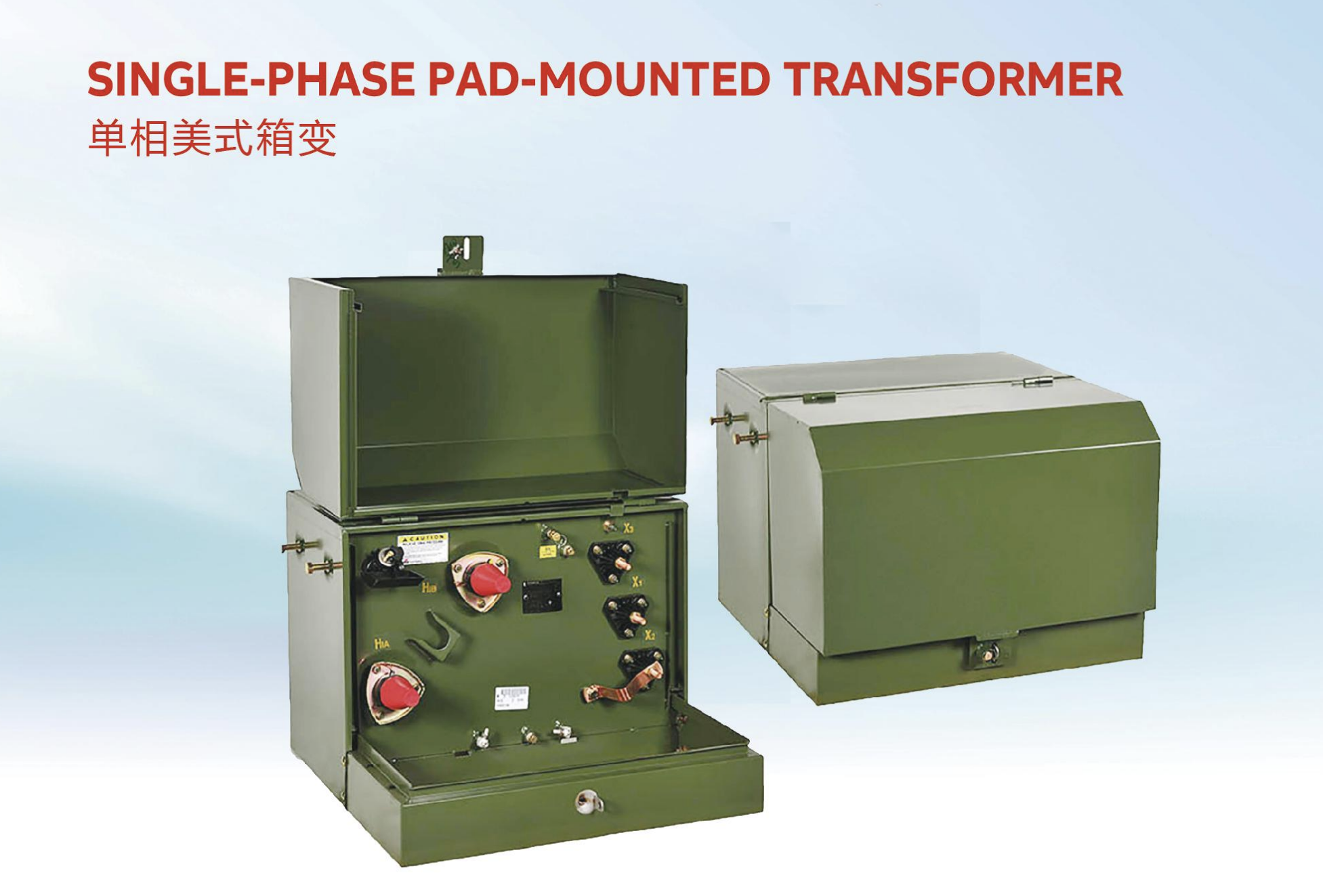
Single-phase pad-mounted transformer, ZGD-H/ZGD-Z series, 15–250 kVA, epoxy-resin elbow bushings and 120/240 V centre-tapped secondary.
| Attribute | Single-phase ZGD-H / ZGD-Z | Three-phase ZGS-H / ZGS-Z |
|---|---|---|
| Rated capacity | 15–250 kVA | 75–2500 kVA |
| High-voltage connection | Epoxy-resin elbow bushings | Epoxy-resin moulded bushings with elbow connectors; 4.16–34.5 kV or customised |
| Low-voltage output | 120/240 V centre-tapped winding | 240 / 480 / 600 / 347 V or customised; copper busbar terminals |
| Core | Amorphous alloy or silicon steel, optional | Low-loss grain-oriented silicon steel with step-lap joints |
| Tank | Carbon-steel welded fully sealed tank | Stainless-steel or carbon-steel welded fully sealed tank |
| Cooling | Natural mineral-oil cooling | Natural mineral-oil circulation |
| Switching and protection | Specified per the purchasing utility requirement | Load-break switch, fuse and surge arrester; loop-feed configuration optional |
| Market conformity | ANSI/IEEE compliant, UL/CSA certified | ANSI/IEEE compliant, UL/CSA certified |
| Typical duty | Residential, rural electrification, retail, street lighting | Commercial, industrial park, municipal utility, renewable distribution |
Worked example: the ZGS-H/ZGS-Z series for the United States, Canada and Mexico
The ZGS-H/ZGS-Z series is the three-phase pad-mounted family in the Apex Power Systems supply range, and it is a useful example because its documentation covers the four items a North American utility actually checks: the capacity band, the voltage classes, the conformity route and the mechanical build.
Capacity runs from 75 to 2500 kVA, which spans a single residential development up to a commercial or light-industrial site. High-voltage classes are 4.16, 12.47, 13.2, 13.8, 22.86, 24.94 and 34.5 kV, or customised values, and low voltage is 240, 480, 600 or 347 V or customised, at 50 or 60 Hz. Insulation levels are to ANSI/IEEE standards, the units are UL and CSA certified, and efficiency is documented against DOE (2016) and CSA (2023). Those four lines are the ones to keep in view when comparing quotes; a unit that is technically suitable but not certified for the destination market will not be accepted, however good the price looks.
Mechanically, the series is a fully sealed compact design with a small footprint, epoxy-resin moulded high-voltage bushings with elbow connectors, copper busbar low-voltage terminals, a stainless-steel or carbon-steel welded tank, natural mineral-oil circulation and a military green or gray anti-corrosion powder coating. The documentation also cites a corrosion-resistant enclosure for coastal, humid and high-temperature climates, loop-feed and radial-feed configurations, and full-capacity customisation from 75 to 2500 kVA with a flexible MOQ. For projects beyond this capacity band, the wider supply record includes a 15 MVA pad-mounted (box-type) transformer project delivered to an American transmission company — that is evidence of larger box-type scope, not a rating available inside the ZGS series.
How to specify a pad-mounted unit, step by step
The sequence below is written for a first-time buyer and follows the order in which each decision constrains the next. Skipping a step usually means revisiting it after the drawings are issued, which is the expensive way to do it.
Step 1 — Confirm the network layout
Decide whether the unit is fed radially or as part of a loop. Loop-feed is an available configuration on the ZGS-H/ZGS-Z series, and the choice changes the internal switching arrangement. It is a distribution-network decision made by the utility or the network designer, not by the transformer supplier, but it has to reach the supplier before the layout is frozen.
Step 2 — Fix the phase count from the load
Single-phase for residential, street lighting and small retail; three-phase for commercial, industrial-park and renewable-distribution loads. If a site has mixed load, the usual split is a three-phase unit for the commercial core and single-phase units for the surrounding residential lots — but only where the network design supports both, and the reference guidance for North American residential distribution does describe exactly this combination of single-phase pad-mounted or pole-mounted units with three-phase pad-mounted units serving commercial and light-industrial loads.
Step 3 — Set the capacity inside the family range
Capacity follows the calculated load plus the utility planning allowance. Too small, and the unit runs hot under normal peaks; too large, and the project pays for capacity it will not use while no-load losses run continuously. Both families have documented ranges to work within: 15–250 kVA for single-phase ZGD-H/ZGD-Z and 75–2500 kVA for three-phase ZGS-H/ZGS-Z, with the three-phase family customisable across the full band.
Step 4 — Fix the voltages and frequency
Choose the high-voltage class from the network — 4.16, 12.47, 13.2, 13.8, 22.86, 24.94 or 34.5 kV are the documented classes, with customised values possible — and the low-voltage output from 240, 480, 600 or 347 V, or a customised value. Then state the frequency, 50 or 60 Hz. Getting the high-voltage class wrong is the single most costly error in this list, because it invalidates the bushings, the insulation level and the certification route together.
Step 5 — Set the efficiency and conformity target
Name the efficiency requirement explicitly — DOE (2016) and CSA (2023) are the two documented benchmarks on the ZGS series — and name the certification route for the destination country. Apex Power Systems verifies that the certificates it presents are current, in the correct entity name and cover the exact product family being purchased, which is the check most easily missed when a supplier offers a broad catalogue.
Step 6 — Fix the enclosure, finish and environment
Stainless steel or carbon steel tank, and the finish that suits the site. Coastal, humid and high-temperature locations are the ones where the corrosion-resistant enclosure claim has to be tested against the actual specification rather than accepted as a phrase in a brochure. Also confirm the pad dimensions and the footprint before the civil works are let.
Step 7 — Fix the protection package and freeze the data sheet
Specify whether the unit needs the internal load-break switch, fuse and surge arrester, and confirm the termination types. Then freeze the data sheet and confirm in writing the items the utility's own specification controls — vector group, impedance and tapping arrangement among them — because those are network parameters, not catalogue options, and they must match the existing units on the system. Only after that freeze should the order be released.
Pad-mounted or prefabricated cabin: two different answers
Buyers new to the category often meet both terms in the same tender and assume they are alternatives for the same duty. They are not. A pad-mounted unit is an outdoor ground-level transformer with its own tamper-resistant enclosure. A prefabricated cabin substation is a complete substation — high-voltage switchgear, transformer, low-voltage switchgear, compensation, automation, AC/DC supply and environmental control — assembled and tested inside a steel or containerised enclosure and delivered as a module for crane lifting and site connection.
| Attribute | Pad-mounted (ZGS-H / ZGS-Z) | Prefabricated cabin (YBM / ZGS11 / ZGS13) |
|---|---|---|
| Rated capacity | 75–2500 kVA | 500–50,000 kVA |
| Voltage class | 4.16–34.5 kV high voltage, ANSI/IEEE insulation level | 10 / 35 kV |
| Integrated equipment | Transformer plus internal load-break switch, fuse and surge arrester | HV switchgear, transformer, LV switchgear, compensation, automation, AC/DC supply, environmental control |
| Enclosure | Fully sealed welded tank, anti-corrosion powder coating | Containerised steel structure, rock-wool sandwich panels, IP54 / IP55 |
| Ambient range stated | Corrosion-resistant enclosure for coastal, humid and high-temperature climates | –40 °C to +50 °C |
| Installation | Set on a concrete pad, terminations made on site | Transported as a complete unit, crane lifted, on-site connection |
Where an overhead line already exists, the third option is a single-phase pole-mounted unit — the D-M series is documented from 5 to 167 kVA, ANSI/IEEE compliant with DOE/CSA efficiency certification, for temperatures from –40 °C to +40 °C and elevations up to 2000 m. The choosing rule is simple enough: pad-mounted where distribution is underground and the unit must stand at ground level; pole-mounted where the line is overhead; prefabricated cabin where the project needs a complete substation rather than a transformer alone.
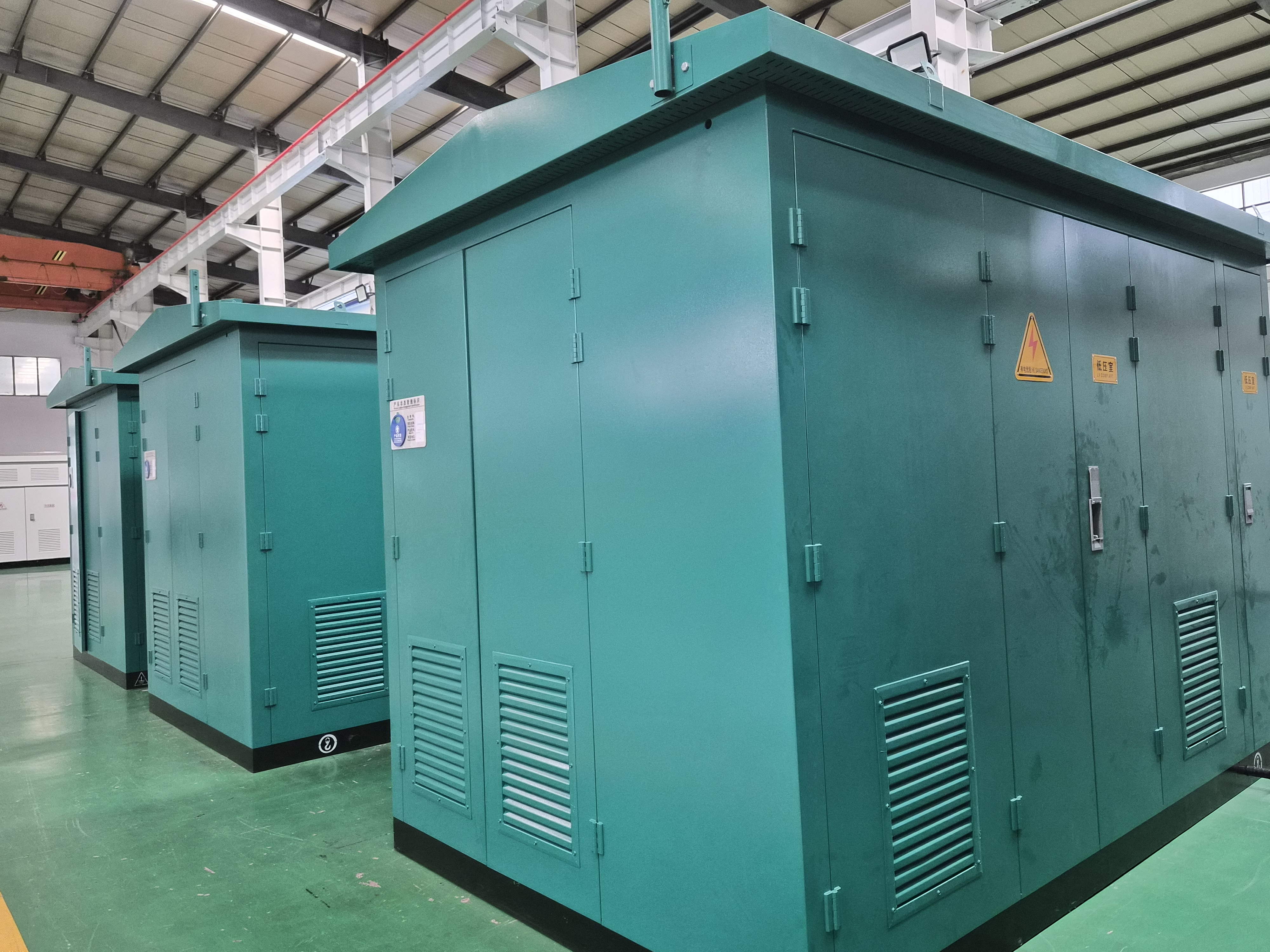
Prefabricated cabin modular substation — a complete substation in one module, distinct from a pad-mounted distribution transformer.
Where pad-mounted units are used
The application list for the ZGS-H/ZGS-Z family is a fair summary of where the format earns its place. Residential and real-estate developments are the classic case: the unit sits on a pad at the edge of a parking area or verge, close to the load, with buried cables and no visible overhead equipment. Commercial complexes and industrial parks use three-phase units where a tenant needs 480 V or 600 V service and the network is underground.
Municipal works and public utilities use pad-mounted units for street lighting, small pumping and public-building supply, where a fenced substation would be out of place. Distribution-side renewable-energy plants use them as the final step-down or collection point where a plant connects into an underground distribution network. Corrosion resistance matters most in the last group and in coastal or high-humidity locations, which is why the enclosure material and coating deserve a line of their own on the data sheet rather than a footnote.
For a first project, the simplest reliable pattern is to buy the transformer and the pad from a supplier who can also state, in writing, which certification route the unit will be delivered under and which drawings the utility will receive. That is a procurement decision as much as an engineering one.
How to verify a supplier before the order is released
Pad-mounted transformers are bought infrequently, which means most buyers evaluate a supplier once and then live with the result. Four checks carry most of the risk out of that decision.
First, establish who the manufacturer actually is. Apex Power Systems (Nanjing) Co., Ltd. is a trading and supply-partner company, not a factory: it selects, audits and supervises a network of verified Chinese manufacturers, and the certifications and test reports it presents belong to those audited partners. That distinction is worth stating plainly, because a supplier that is honest about being a trading partner can be held to a different and more useful standard — independent factory selection, comparison of more than one plant, and one accountable point of contact from design review through witness testing, packing, freight and site supervision.
Second, check the certificates against the exact product family. The partner base holds ISO 9001:2015, ISO 14001:2015 and ISO 45001:2018 management-system certifications, IEC conformity for 10 kV / 35 kV power transformers and box-type substations, UL product certification, CSA certification and CQC product certification for box-type substations and switchgear, alongside independent verification such as a KEMA Labs Type I Inspection Report for a 250 MVA / 345 kV three-phase power transformer tested to the IEC 60076 series and IEEE Std C57.12.00 / C57.12.90. The question to ask is not whether certificates exist but whether they name the entity, the product family and a validity date that cover your order.
Third, ask whether factory acceptance testing can be witnessed, and whether third-party inspection can be arranged. A dedicated test laboratory with lightning-impulse, no-load and load-loss, ratio, winding-resistance, temperature-rise and insulation test benches is the sort of capability that makes witnessed testing meaningful rather than ceremonial.
Fourth, look for comparable delivered work. The supply record includes the 15 MVA pad-mounted (box-type) project for an American transmission company and a commercial project in Panglao, Philippines, delivered with design, manufacture, on-site delivery, engineering, installation, testing and trial operation — the two references most directly relevant to a pad-mounted enquiry. The company exports about 70% of its supplied volume, with its main markets in the EU, the USA and the Middle East.
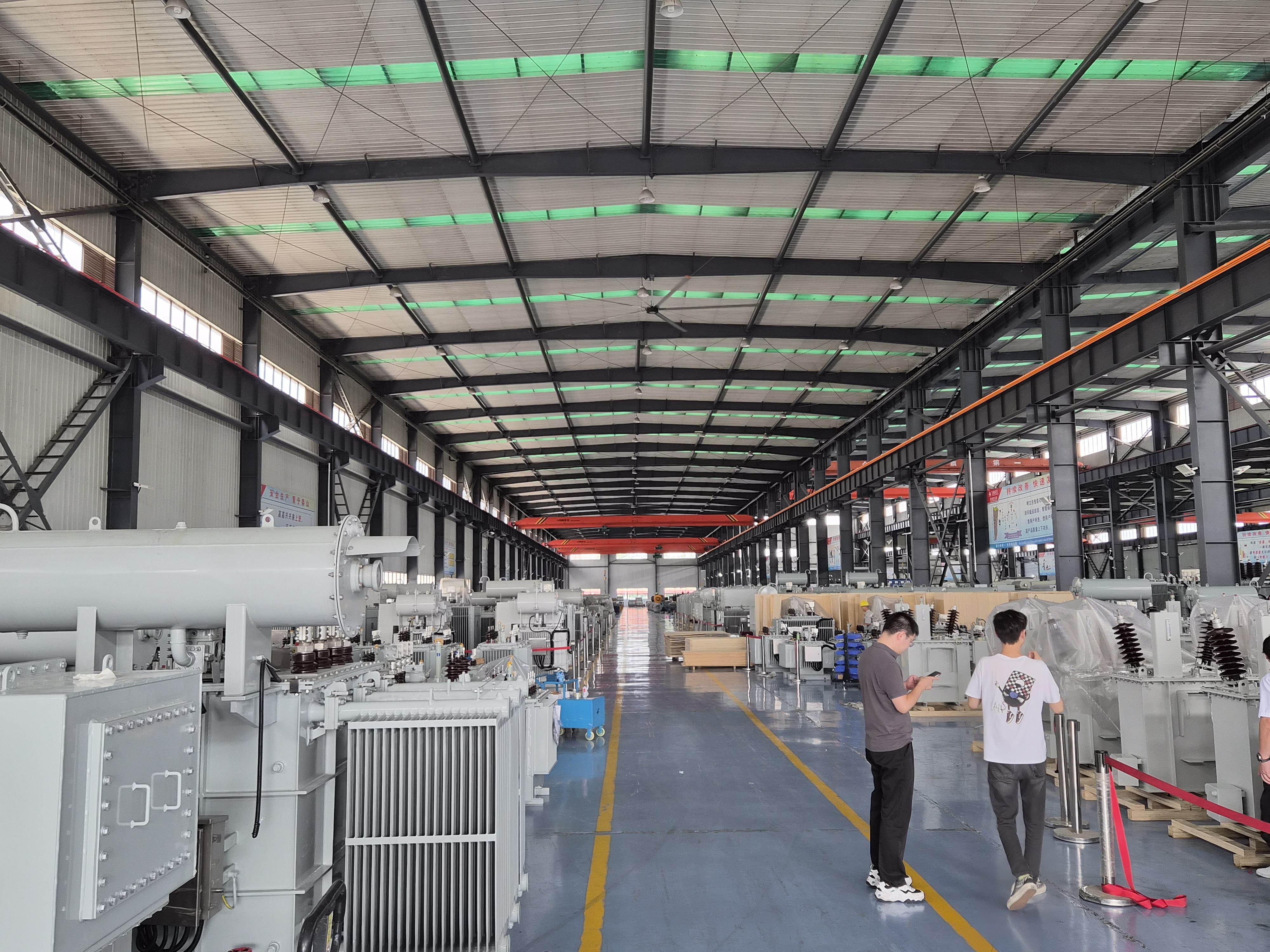
Factory grounds of an audited manufacturing partner — visits and witnessed factory acceptance testing can be arranged as part of an order.
Frequently asked questions
What is a pad-mounted distribution transformer?
A pad-mounted distribution transformer is a liquid-filled distribution transformer installed at ground level on a concrete pad, with its high-voltage and low-voltage switching, fusing and protection enclosed together with the transformer inside a tamper-resistant steel enclosure. Compartmental, dead-front construction and radial or loop feed are the defining features. Because the enclosure is tamper-resistant, the unit can stand in a publicly accessible area without a fenced substation. Ratings of roughly 25 kVA to 500 kVA are typical in service, and units for North America are certified to the UL and CSA standards for liquid-filled distribution transformers rated over 750 V.
What is the difference between a single-phase and a three-phase pad-mounted transformer?
They are separate product families. A single-phase pad-mounted unit serves residential loads, street lighting and small retail; the ZGD-H/ZGD-Z series covers 15–250 kVA with a 120/240 V centre-tapped low-voltage winding for the North American residential system. A three-phase unit serves commercial, industrial-park and renewable-distribution loads; the ZGS-H/ZGS-Z series covers 75–2500 kVA with 240, 480, 600 or 347 V low voltage, or customised values. The windings, bushing arrangement and enclosure layout differ between the two, so the phase count has to be settled before the enquiry, not after the drawings.
What kVA ratings and high-voltage classes are typical?
The three-phase ZGS-H/ZGS-Z series is documented from 75 to 2500 kVA, with high-voltage classes of 4.16, 12.47, 13.2, 13.8, 22.86, 24.94 and 34.5 kV, or customised values, at 50 or 60 Hz. The single-phase ZGD-H/ZGD-Z series is documented from 15 to 250 kVA. In service across North American residential and small commercial distribution, single-phase units of roughly 25 kVA to 100 kVA are common, with 50 kVA and 75 kVA units at 7200/2400 V and a 120/240 V secondary frequently encountered. Capacity should follow the calculated load plus the utility planning allowance rather than a round number.
What do ANSI/IEEE, UL, CSA and DOE/CSA efficiency mean for a pad-mounted order?
They are three separate conformity checks, not one badge. ANSI/IEEE defines the insulation level the unit is built to, and the ZGS-H/ZGS-Z series is specified to ANSI/IEEE standards. UL and CSA are product certifications for the destination market — UL for the United States, CSA for Canada, with CSA C2.1-06 and CSA C227.4 named in the reference guidance for liquid-filled distribution transformers. DOE (2016) and CSA (2023) are the energy-efficiency benchmarks documented for the series. All three should appear on the data sheet with the specific standard cited, and none of them replaces the purchasing utility's own specification.
How should a buyer shortlist China custom transformer manufacturers?
The practical test is not catalogue size but whether the supplier can evidence the exact product family, certification and test record you are buying. Ask for the certificate number, issuer, validity and the product family each certificate covers. Ask who the manufacturer actually is, because many suppliers are trading and audit partners rather than factories. Ask whether factory acceptance testing can be witnessed and whether third-party inspection is available. Apex Power Systems works on that model — a trading and supply partner that audits, selects and supervises the manufacturing partners whose certificates it presents, rather than a factory selling its own output.
What information is needed to request a quotation, and what happens next?
Send the phase count, rated capacity, high-voltage class, low-voltage voltage, frequency, efficiency target, enclosure finish and protection package, together with the destination country so the certification route can be confirmed. With those eight items a supplier can quote a defined unit instead of a category. Apex Power Systems handles enquiries at xuke@apexps-nj.com and +86 132-0157-1341; the product catalogue is available as a PDF for a first technical review, and drawings, factory test reports and operating manuals are issued in the format the purchasing utility or EPC requires.
Conclusion: the decision in one paragraph
A pad-mounted distribution transformer is defined less by the transformer inside it than by the enclosure, the dead-front termination and the pad that let it stand unguarded at ground level in an underground distribution network. The first real decision is the phase count, because single-phase and three-phase units are separate families with separate capacity bands and low-voltage outputs. The second is the voltage and capacity set, taken from the network rather than from a catalogue. The third is conformity — ANSI/IEEE insulation level, UL or CSA certification for the destination market, and a stated efficiency benchmark — confirmed against the exact product family and the exact entity named on the certificate. Get those three right and the rest of the data sheet follows.
For readers who want the full technical scope, the Apex Power Systems catalogue covers pad-mounted, pole-mounted, dry-type and oil-immersed transformers together with prefabricated cabin substations, and is available for download here: Apex Power Systems product catalogue (PDF). Enquiries for a specific pad-mounted configuration can be sent to xuke@apexps-nj.com or +86 132-0157-1341, quoting the eight specification items listed above so that the first response is a defined unit rather than a general description.
Substation and transformer scope available through Apex Power Systems and its audited manufacturing partners — catalogue and drawings on request.
Have Questions or Need More Details?
Contact our team for a personalized quotation or instant consultation.
Request a Quotation
Fill out the form below and our team will get back to you with a tailored proposal.
WhatsApp Direct Chat
Prefer to chat in real-time? Message us on WhatsApp for instant assistance & quick answers.
- Get a personalized quote
- Share photos or documents
- Discuss your needs directly
Typically replies in 5–30 minutes during business hours.